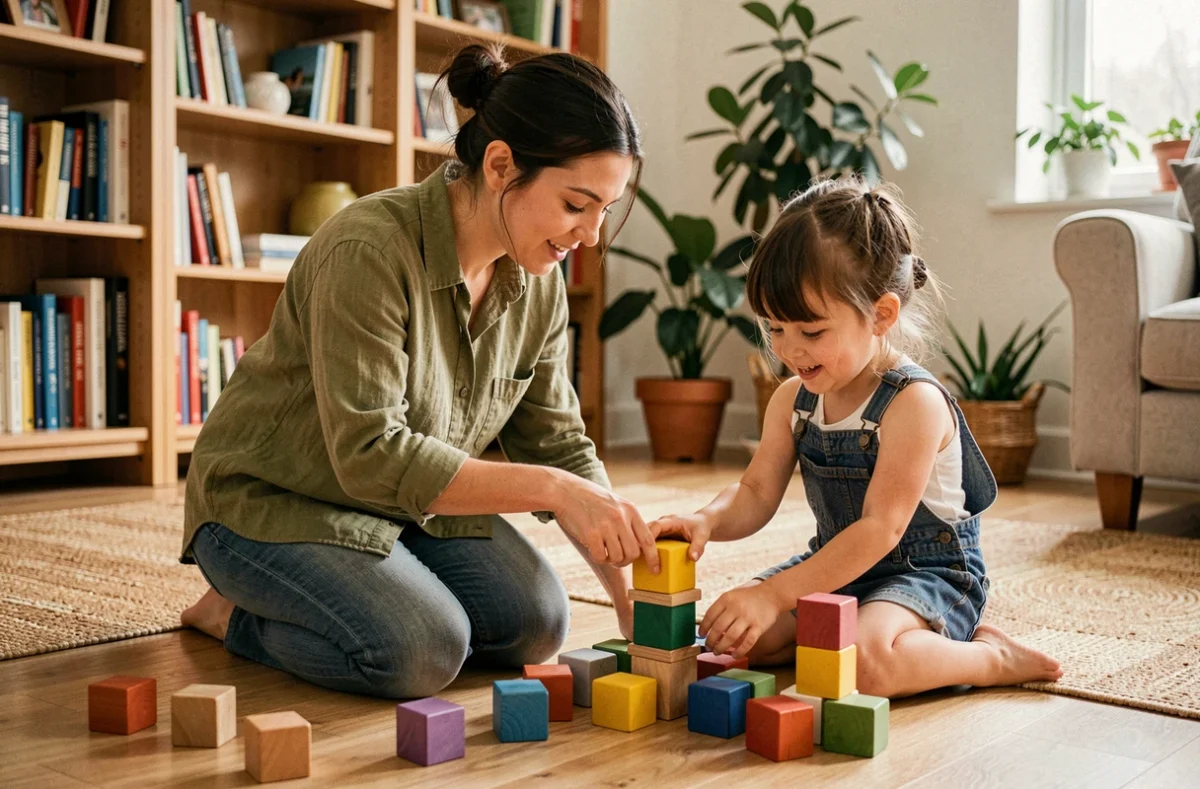
Everyday activities with a child are about more than ticking off a list of crafts. What shapes learning over time are repeated micro-interactions: conversations while preparing a meal, negotiating which book to choose, and solving practical problems while tidying up. The Scientific Council for National Education links these informal exchanges to positive cognitive and language development, without the need for specialized educational materials.
Structured routines and informal learning in children
Household routines are an underrated tool. Creating a predictable framework around sleep, quiet time, and meals supports a child’s cognitive readiness far more than directly helping with homework. The Scientific Council for National Education’s review confirms that establishing routines is more effective than supervising homework.
In practice, this means setting clear time markers. A child who knows that free play follows their snack, then comes reading time, and then bath time, learns a sequence that reduces conflict and encourages independence. This isn’t about being rigid: it’s about providing a framework in which children can make decisions (which book, which game, which task they’ll take responsibility for).
Household chores contribute directly to this framework. Sorting cutlery develops categorization skills, watering plants introduces the idea of ongoing responsibility, and writing a shopping list builds functional literacy. Every household task shared with a child is an opportunity to learn, as long as it involves conversation rather than silence.
For more ideas on this approach, Happy Licorne’s tips for children offer additional suggestions for different ages.
Reading together: beyond the bedtime ritual
Limiting reading to bedtime means missing out on its full potential. The Ministry of National Education recommends letting children choose their books and varying reading times throughout the day. Looking through a picture book after school or reading a nonfiction book during snack time won’t have the same effect as insisting on a story at 8:30 p.m. when attention is fading.
Three principles can make shared reading more effective:
- Offer a choice between two or three titles rather than imposing a book. This involves the child in the decision and boosts their motivation.
- Ask open-ended questions about the illustrations or story (“What do you think will happen next?”) to encourage inferential reasoning.
- Reread the same books without feeling guilty: repetition strengthens vocabulary and narrative comprehension in young children.
Consistency matters more than duration. Ten minutes of interactive reading every day is more effective than thirty minutes of passive reading once a week.
Cognitive games without educational materials
Classic board games develop measurable executive skills: inhibition, flexibility, and working memory. You don’t need toys labeled “educational” to achieve these benefits. A simple card game like War helps children compare numbers. Memory games engage visual-spatial memory. Open-ended building activities (blocks, Kapla, cardboard boxes) develop planning and problem-solving skills.
Physical activities work in much the same way. Jumping over a rope laid on the floor, catching soap bubbles, or setting up an obstacle course with cushions all build coordination and anticipation skills without requiring any investment. The real measure isn’t the cost of the materials, but the active presence of an adult who talks things through, encourages the child, and adjusts the difficulty.
The trap of too much specialized equipment
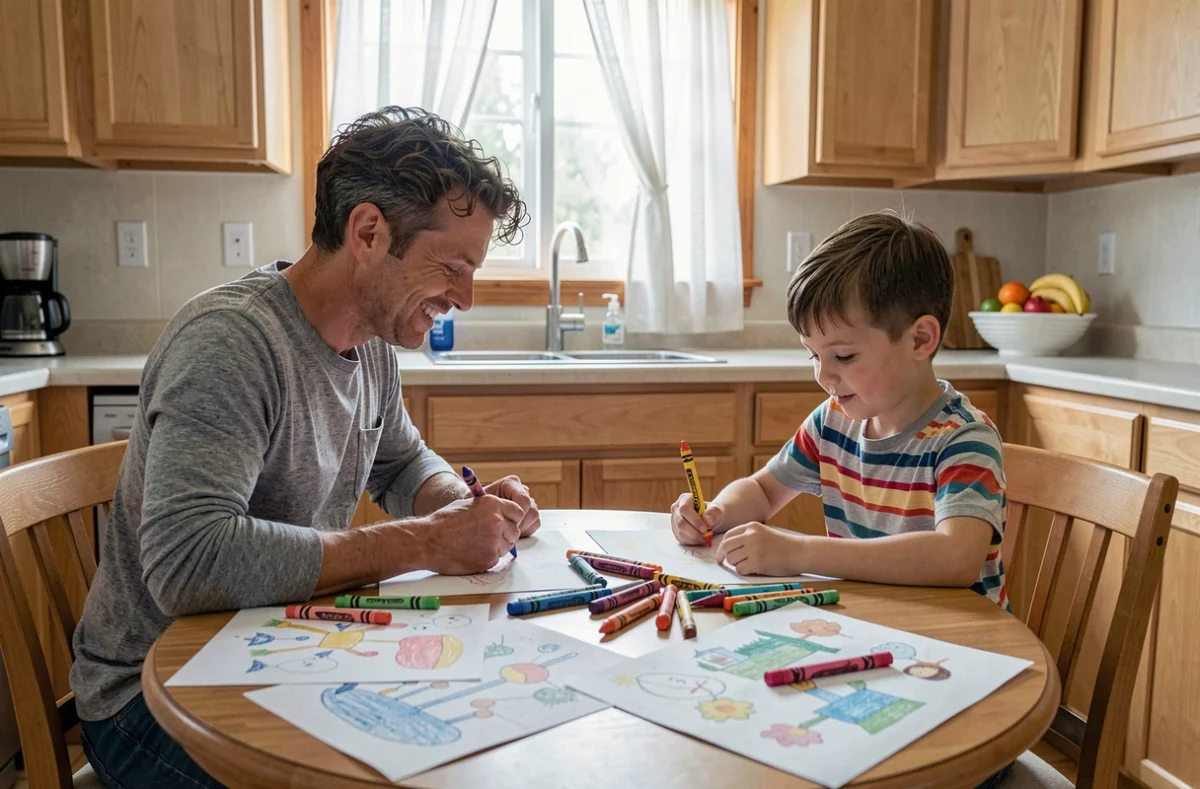
We’re seeing a trend toward buying more and more specialized developmental toys, even though research points in the opposite direction. An environment overloaded with stimuli can scatter a child’s attention. A few versatile items (blocks, crayons, modeling clay, books) are enough to support pretend play, fine motor skills, and creativity.
The point isn’t to have the right toy, but to use what’s already at home as a way to interact. A cardboard box can become a boat, a house, or a tunnel. It’s the child’s imagination that does the work, not the object.

Everyday screen use: moving beyond the either-or debate
Public Health France notes that some digital activities support learning, while others pose risks. Treating screens and educational activities as opposites doesn’t reflect how families actually use them. A child using a drawing app or watching a wildlife documentary is in a very different situation from one passively scrolling through videos on repeat.
What makes the difference:
- Using screens together—when an adult watches and comments alongside the child—turns passive screen time into active conversation.
- Continuous screen time matters more than total screen time: two 20-minute sessions with physical activity in between are better than one uninterrupted 40-minute block.
- Content choice remains crucial. Parents should guide it, rather than leaving it to the platform’s algorithm.
Rather than banning screens, the goal is to guide children’s use. Clear boundaries (no screens during meals, no screens in the hour before bedtime) work better than a blanket ban, which can lead to frustration and conflict.
Supporting a child every day comes down to simple, repeated actions. Establish routines, read together at different times, play with what’s on hand, and set limits on screen use without demonizing it: these regular habits build independence and confidence, not occasional big outings or purchases of specialized equipment. Often, the most effective approach is also the most accessible.