
The 421 is based on a token redistribution mechanism in two asymmetric phases. The charge and discharge are not just simple successive rounds: they reverse the logic of the game, and this inversion is precisely what separates regular players from occasional ones.
Pot Management and Combination Hierarchy in 421
The game starts with a central pot of 21 tokens. In the charge phase, each losing player retrieves tokens from the pot based on the combination obtained by the winning player of the round. The charge ends when the pot is empty.
The discharge reverses the mechanics: the loser must give their own tokens to the winner. The first player to get rid of all their tokens wins the game. This asymmetry means that accumulating many tokens during the charge is not prohibitive if the discharge strategy is mastered, but it imposes a real handicap by prolonging the second phase.
The hierarchy of combinations determines the number of tokens exchanged. The 4-2-1 (the eponymous combination) yields the maximum. Next come the three-of-a-kinds, ranked from 1-1-1 (the strongest) to 6-6-6, followed by straights (sequences of three consecutive numbers like 3-2-1), and finally the raw points. One detail that most tables apply without stating: three-of-a-kinds of 1 surpass all other three-of-a-kinds, including 6-6-6, which reverses the usual numerical logic.
We recommend consulting the rules of the game 421 on HyperScoop for a detailed presentation of the token scale associated with each combination.
Regional Variants of 421: What Changes from Table to Table
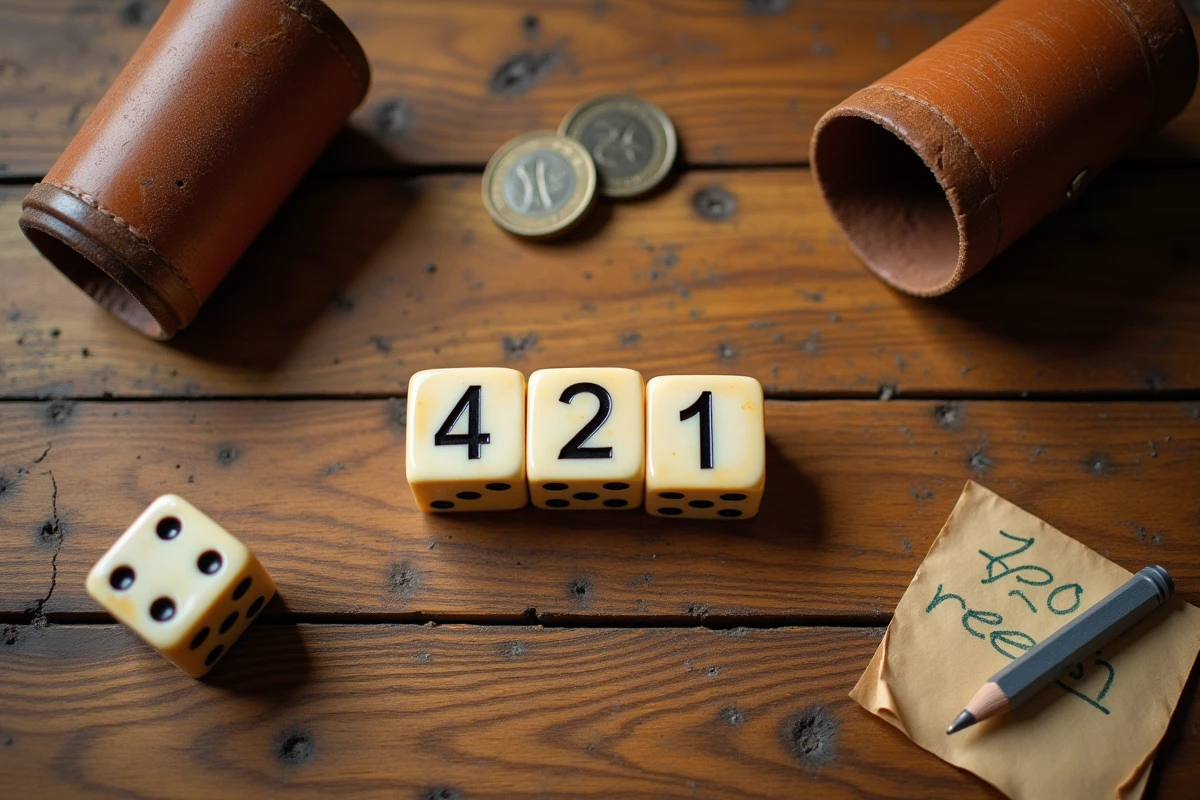
The 421 has no federation or unified rules. The variants are not anecdotal: they modify the underlying strategy.
- The value of 6-6-6 varies by environment. In some cafés in southern France, the three-of-a-kind of 6 is placed above the three-of-a-kind of aces, reversing the classic hierarchy. At other tables, it is worth only two tokens instead of three.
- The sequence 4-3-2 is sometimes recognized as a valid straight, sometimes ignored. Its absence from the scale requires recalculating the probabilities of winning on each roll.
- The number of allowed re-rolls ranges from two to three depending on the regions. Reducing from three to two re-rolls significantly decreases the ability to correct a poor first roll and favors combinations obtained quickly.
- The treatment of the “nénette” (2-2-1) differs: some circles assign it the value of a straight, while others consider it a simple score of points.
These discrepancies explain why an experienced player in one context may find themselves destabilized at another table. Before playing, the only useful precaution is to check three points: the ranking of three-of-a-kinds, the number of re-rolls, and the recognition (or not) of straights.
421 Vocabulary to Read a Table Without Hesitation
The jargon of 421 is not decorative. Each term refers to a specific game situation, and confusing them slows down the game.
The “charge” refers to the phase of distributing tokens from the pot, while the “discharge” is when players get rid of them. The “fichu” (or “fiche”) is the token itself. The “nénette” refers to the combination 2-2-1. The “barbu” corresponds to 1-1-1, the three-of-a-kind of aces.
The term “cul” refers to the player who lost the round and must retrieve or give away tokens. At some tables, “plomb” is used for a player heavily loaded with tokens at the start of the discharge. Knowing this lexicon allows one to keep up with the pace of a game among regulars without interrupting the game to ask for clarifications.
Re-Roll Tips in 421: When to Keep and When to Re-Roll Everything

The decision to re-roll is the only strategic lever in a game largely governed by chance. After the first roll of three dice, the player can keep one or more dice and re-roll the others (within the limits allowed by the table).
Keeping a 4 and a 2 to try for a 1 on the third die is the classic reflex, but it only makes sense during the charge when the maximum gain of tokens is the goal. In discharge, the logic reverses: aiming for a three-of-a-kind of aces or even a simple straight may be enough to transfer tokens, with a significantly more favorable probability than the 4-2-1.
Another underestimated point: re-rolling all three dice when the first roll gives a mediocre result (for example, 6-5-3) is not a sign of nervousness. It is often the mathematically optimal decision, as keeping a single useless die reduces flexibility without improving the chances of a strong combination.
In discharge with many tokens, we observe that seasoned players prefer consistency (average three-of-a-kinds, straights) over hunting for the 4-2-1. Reducing variance takes precedence over seeking the spectacular move when the stock of tokens to be offloaded is significant.
421 Beyond the Bar: Uses in Animation and Cognitive Stimulation
The 421 is recommended in animation contexts for elderly people. The FNADEPA, in its 2021 report “Games and Memory,” identifies it as a tool for attention, mental calculation, and decision-making. Counting tokens, quickly evaluating combinations, and managing re-rolls engage complementary cognitive functions.
This shift from the bistro to socio-educational animation is not trivial. The 421 is also increasingly played during organized tournaments and themed evenings, rather than in daily practice at the counter. The game is migrating from spontaneous use to a structured event framework, which contributes to solidifying the rules around a more homogeneous “tournament” version.
This gradual standardization does not eliminate regional variants, but it creates two layers of practice: that of competitions with a fixed scale and that of informal tables where negotiating the rules is part of the ritual at the start of the game. Knowing which context one is in before rolling the dice remains the best advice for a player discovering a new table.